La nueva función de tarjetas de memoria es útil para memorizar preguntas.
?Cambia tu modo de estudio
En cualquier momento, puedes cambiar el modo de estudio y alternar entre el modo de práctica y el modo de examen. En el modo de práctica, puedes configurar, por ejemplo, el número de preguntas o test, y otros parámetros para ayudarte a estudiar.
Aleatorizado | 10 Preguntas por test | 20 Minutos | 70% para aprobar|
Para volver a configurar su modo de estudio nuevamente y cambiar, por ejemplo, el número de test, ya sea que tenga preguntas aleatorias y todos los demás parámetros de configuración.
?Configuración del simulador
Autodesplazamiento: puede usar el desplazamiento automático del test que ocurre tan pronto como responda una o todas las respuestas a una pregunta correctamente. El desplazamiento automático se activa si respondes una sola respuesta, o tan pronto como respondas todas las respuestas obligatorias. Modo de aprendizaje: durante el modo de aprendizaje puedes obtener un resultado en tiempo real para tu respuesta.
Prueba gratuita
Pregunta: / 10
20:00Min. restantes
?Reiniciar el test actual
Para reiniciar el test actual limpiando todas sus respuestas y el tiempo utilizado hasta ahora. ADVERTENCIA: Todas las respuestas se perderán.
Pregunta: / 10
4.9(660 Votos)
Test
Pregunta 1/101/10
Subsonic Aerodynamics
Subsonic Aerodynamics
Subsonic Aerodynamics
An aeroplane flying with an airspeed of 200 kt and CL is equal to 0.6. The pilot is requested to increase speed to 250 kt by the ATC. The new CL is...
Seleccione la respuesta:Seleccione la respuesta
1 respuesta correcta
A.
0.47
B.
0.38
C.
0.2
D.
0.40
The lift coefficient (CL) is directly proportional to the airspeed of the aeroplane. Therefore, when the pilot increases the airspeed from 200 kt to 250 kt, the new CL decreases accordingly. In this case, with the new airspeed of 250 kt, the new CL is calculated to be 0.38.
Respuesta Correcta: B
Test
Pregunta 2/102/10
Propellers
Propellers
Propellers
For a twin-engine aeroplane, a reason for limiting a propeller's diameter is to...
Seleccione la respuesta:Seleccione la respuesta
1 respuesta correcta
A.
avoid excessive propeller-tip velocities at high RPMs.
B.
increase ground clearance.
C.
avoid a reduction in power absorption.
D.
reduce the aeroplane's minimum control speed.
Limiting a propeller's diameter for a twin-engine aeroplane is necessary to avoid excessive propeller-tip velocities at high RPMs.
Respuesta Correcta: A
Test
Pregunta 3/103/10
Stall, Mach Tuck, And Upset Prevention And Recovery
Stall, Mach Tuck, And Upset Prevention And Recovery
Stall, Mach Tuck, And Upset Prevention And Recovery
An aeroplane has a stall speed of 100 kt. When the aeroplane is flying a level co-ordinated turn with a load factor of 1.5, the aeroplane will stall in this turn at:
Seleccione la respuesta:Seleccione la respuesta
1 respuesta correcta
A.
150 kt.
B.
122 kt.
C.
82 kt.
D.
141 kt.
In a level co-ordinated turn with a load factor of 1.5, the stall speed will increase by the square root of the load factor. Therefore, the aeroplane will stall in this turn at approximately 122 kt.
Respuesta Correcta: B
Test
Pregunta 4/104/10
Limitations
Limitations
Limitations
The speed VC in gust diagram...
Seleccione la respuesta:Seleccione la respuesta
1 respuesta correcta
A.
equals 55 ft/s.
B.
equals 50 ft/s.
C.
equals 25 ft/s.
D.
equals 66 ft/s.
In a gust diagram, the speed VC represents the minimum speed required to maintain level flight in turbulent conditions.
Respuesta Correcta: B
Test
Pregunta 5/105/10
High-speed Aerodynamics
High-speed Aerodynamics
High-speed Aerodynamics
Assuming ISA conditions and a climb above the tropopause at constant Mach number and aeroplane mass, the: (note: assume maintaining constant thrust)
Seleccione la respuesta:Seleccione la respuesta
1 respuesta correcta
A.
IAS increases.
B.
TAS decreases.
C.
lift coefficient increases.
D.
lift coefficient decreases.
When climbing above the tropopause at constant Mach number and aeroplane mass, the lift coefficient increases due to the reduction in air density which requires higher lift to maintain level flight.
Respuesta Correcta: C
Test
Pregunta 6/106/10
Flight Mechanics
Flight Mechanics
Flight Mechanics
After suspecting a fuel leak, the aircrew flying a jet transport aircraft decides to divert to the nearest suitable airport. At what speed should they fly?
Seleccione la respuesta:Seleccione la respuesta
1 respuesta correcta
A.
Maximum Range Speed
B.
Maximum Endurance Speed
C.
MMO
D.
Long Range Speed
The aircrew should fly at Maximum Range Speed when diverting to the nearest suitable airport after suspecting a fuel leak in a jet transport aircraft.
Respuesta Correcta: A
Test
Pregunta 7/107/10
Control
Control
Control
Outboard ailerons are (1) at (2) speeds, to prevent (3) .
Outboard ailerons are locked at high speeds, to prevent aileron reversal.
Respuesta Correcta: A
Test
Pregunta 8/108/10
Stability
Stability
Stability
Dihedral contributes positively to lateral stability by:
Seleccione la respuesta:Seleccione la respuesta
1 respuesta correcta
A.
Increasing lift on the wing away from the wind.
B.
Increasing drag on the wing away from the wind.
C.
Increasing the lift on the wing into the wind.
D.
Increasing drag on the wing into the wind.
Dihedral contributes positively to lateral stability by increasing the lift on the wing into the wind.
Respuesta Correcta: C
Test
Pregunta 9/109/10
Subsonic Aerodynamics
Subsonic Aerodynamics
Subsonic Aerodynamics
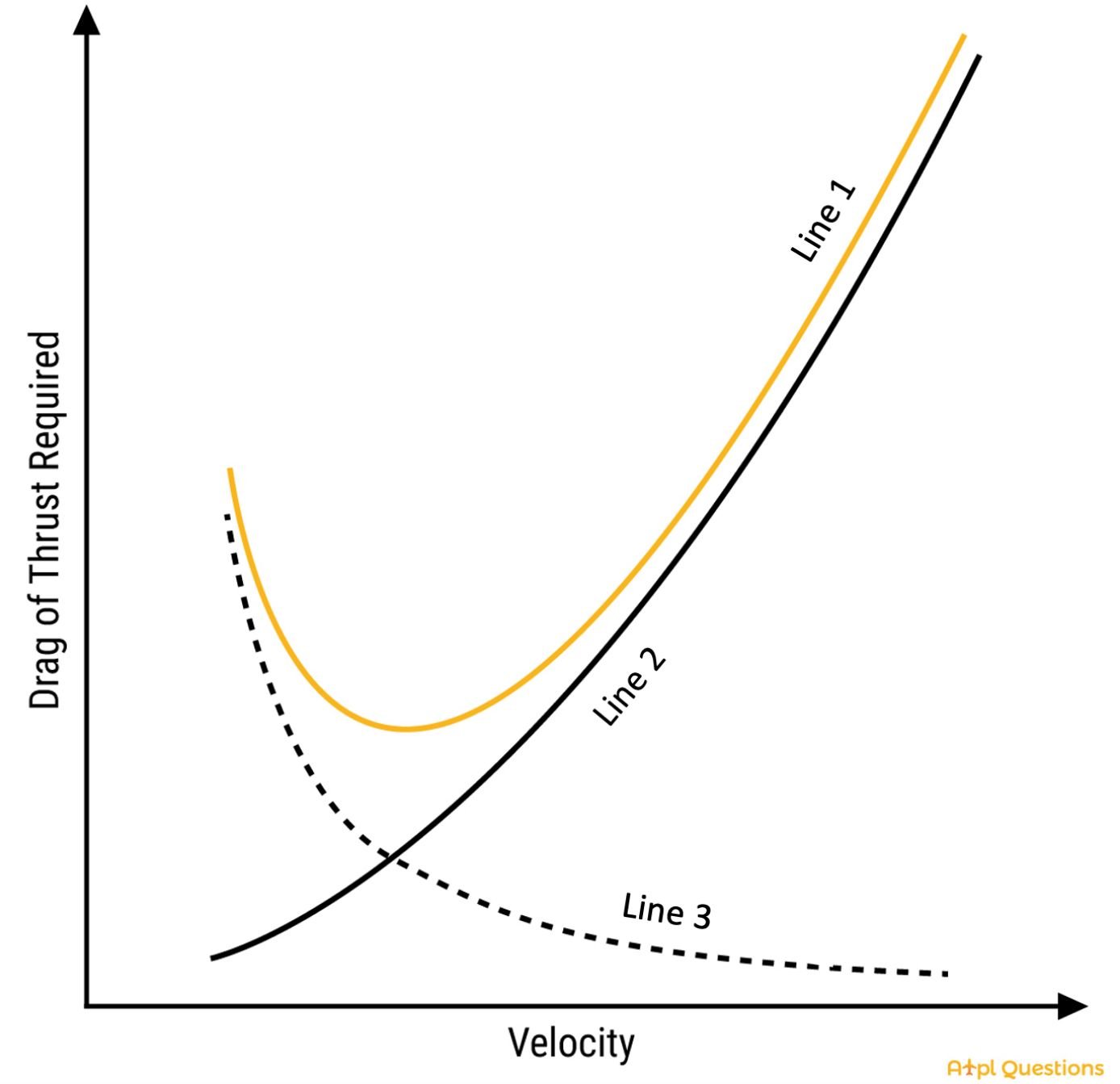
Refer to figure. What does line 3 represent?
Seleccione la respuesta:Seleccione la respuesta
1 respuesta correcta
A.
Induced drag
B.
Parasite drag
C.
Total drag
D.
Profile drag
.
Respuesta Correcta: A
Test
Pregunta 10/1010/10
Propellers
Propellers
Propellers
In twin engine aeroplanes with propellers turning clockwise as seen from behind:
Seleccione la respuesta:Seleccione la respuesta
1 respuesta correcta
A.
the left engine is the critical engine.
B.
the ‘minimum control speed’ is determined by the failure of the right engine.
C.
the left engine produces a higher yaw moment if the right engine fails than vice versa.
D.
the right engine is the critical engine.
In twin engine aeroplanes with propellers turning clockwise as seen from behind, the left engine is considered the critical engine because it produces more yawing moment in the event of an engine failure.
Test ATPL (A) Principles of Flight Los test de práctica desbloquean todas las preguntas del simulador online
¡Gracias por elegir la versión gratis de prueba de práctica test de Test ATPL (A) Principles of Flight ! Profundiza aún más tus conocimientos con Simulador de Examen Licencia ATPL Avión; desbloqueando la versión completa de nuestro simulador de Test ATPL (A) Principles of Flight podrás hacer test con más de 1204 preguntas actualizadas constantemente y aprobar fácilmente tu examen. El 98% de la gente aprueba el examen a la primera después de prepararse con nuestras 1204 preguntas.
¿Qué esperar de nuestros Test ATPL (A) Principles of Flight test de práctica y cómo prepararte para cualquier examen?
Los test de práctica Test ATPL (A) Principles of Flight del simulador son parte de la Examen Licencia ATPL Avión Base de datos y son la mejor manera de prepararse para cualquier examen de Test ATPL (A) Principles of Flight.
Los test de práctica de Test ATPL (A) Principles of Flight consisten en 1204 preguntas divididas por 8 temas y están escritas por expertos para ayudarte a aprobar el examen en el primer intento. La base de datos de Test ATPL (A) Principles of Flight incluye preguntas de exámenes anteriores, lo que significa que podrás practicar preguntas anteriores y futuras. La preparación con el simulador de Test ATPL (A) Principles of Flight te dará también una idea del tiempo que te llevará completar cada sección de los test de práctica de Test ATPL (A) Principles of Flight . Es importante saber que el Simulador de Test ATPL (A) Principles of Flight no reemplaza las clásicas guías de estudio de Test ATPL (A) Principles of Flight ; aún así, el Simulador ofrece información útil sobre qué esperar y cuánto tendrás que practicar para estar preparado para el día del examen de Test ATPL (A) Principles of Flight .
Los test de práctica de Test ATPL (A) Principles of Flight representan una excelente herramienta para prepararte para el examen real junto con nuestros test de práctica de Examen Licencia ATPL Avión . Nuestro Simulador de Test ATPL (A) Principles of Flight te ayudará a evaluar tu nivel de preparación y a entender tus fortalezas y debilidades. Abajo puedes leer todos los test que encontrarás en nuestro simulador de Test ATPL (A) Principles of Flight y cómo nuestra base de datos de Test ATPL (A) Principles of Flight compone preguntas reales:
Información del test:
Nombre del test:Test ATPL (A) Principles of Flight
Número total de preguntas:1204
Número de preguntas para el test:100
Puntuación de aprobado:70%
Número de temas:8 Temas
Temas de estudio:Número de preguntas:
Control:77 Preguntas
Flight Mechanics:150 Preguntas
High-speed Aerodynamics:117 Preguntas
Limitations:59 Preguntas
Propellers:104 Preguntas
Stability:98 Preguntas
Stall, Mach Tuck, And Upset Prevention And Recovery:146 Preguntas
Subsonic Aerodynamics:453 Preguntas
Puedes prepararte para los exámenes de Test ATPL (A) Principles of Flight con nuestra aplicación móvil. Es muy fácil de usar e incluso funciona sin conexión a internet, con todas las funciones que necesitas para estudiar y practicar con nuestro Simulador de Test ATPL (A) Principles of Flight .
Usa nuestra aplicación móvil, disponible para dispositivos Android e iOS, con nuestro Simulador de Test ATPL (A) Principles of Flight . Puedes usarla donde quieras y recuerda siempre que nuestra app es gratis y disponible en todas las App Stores.
Nuestra aplicación móvil contiene todos los test de práctica de Test ATPL (A) Principles of Flight, que constan de 1204 preguntas divididas en 8 temas y ofrecen material de estudio para aprobar el examen final de Test ATPL (A) Principles of Flight con éxito garantizado.
Nuestra base de datos de Test ATPL (A) Principles of Flight contiene cientos de preguntas y test de Examen Licencia ATPL Avión relacionados con el examen de Test ATPL (A) Principles of Flight. Así puedes practicar donde quieras, incluso sin conexión a internet.