The new flashcard feature is useful to memorize questions.
?Change your study mode
At any time, you can change the study mode, and alternate between the practice mode and the exam mode. In practice mode, you can configure for example the number of questions or tests, and other parameters to help you study.
Randomized | 10 Questions Per Test | 20 Minutes | 70% to pass|
To re-configure your study mode again and change - for example - the number of tests, whether you have random questions and all other configuration parameters.
?Simulator Configuration
Auto-scroll: You can use the automatic scrolling of the questionnaire that occurs as soon as you answer one or all of the answers to a question correctly. Auto scrolling is activated if you answer a single answer, or as soon as you answer all the mandatory answers. Learning Mode: During learning mode you can get a real time result for your answer.
Free Test
Question: / 10
20:00Min. left
?Restart the current test
To restart the current test by clearing all your answers and the time used up to now. Warning: all answers will be lost.
Question: / 10
5.0(660 Votes)
Quiz
Question 1/101/10
Basic Radio Propagation Theory
Basic Radio Propagation Theory
Basic Radio Propagation Theory
Given the following information, what is the true bearing from the NDB to the aircraft?Compass Heading: 241°Relative Bearing Indicator (RBI) - needle head: 162°Deviation: +3°Variation: 13°EThe effect of convergence can be ignored.
Select the answer:Select the answer
1 correct answer
A.
239°(T)
B.
223°(T)
C.
233°(T)
D.
213°(T)
The true bearing from the NDB to the aircraft is calculated by subtracting the Deviation (+3°) and Variation (13°E) from the Compass Heading (241°). Therefore, 241° - 3° - 13° = 225°. Since the RBI needle head is at 162°, the relative bearing is 162° which means the aircraft is 162° to the right of the true bearing. To find the true bearing, we subtract the relative bearing from the calculated bearing, so 225° - 162° = 63°. However, since the RBI shows the bearing from the aircraft to the NDB, we take the reciprocal of 63° which is 243°. Hence, the true bearing from the NDB to the aircraft is 243°(T).
Right Answer: A
Quiz
Question 2/102/10
Radio Aids
Radio Aids
Radio Aids
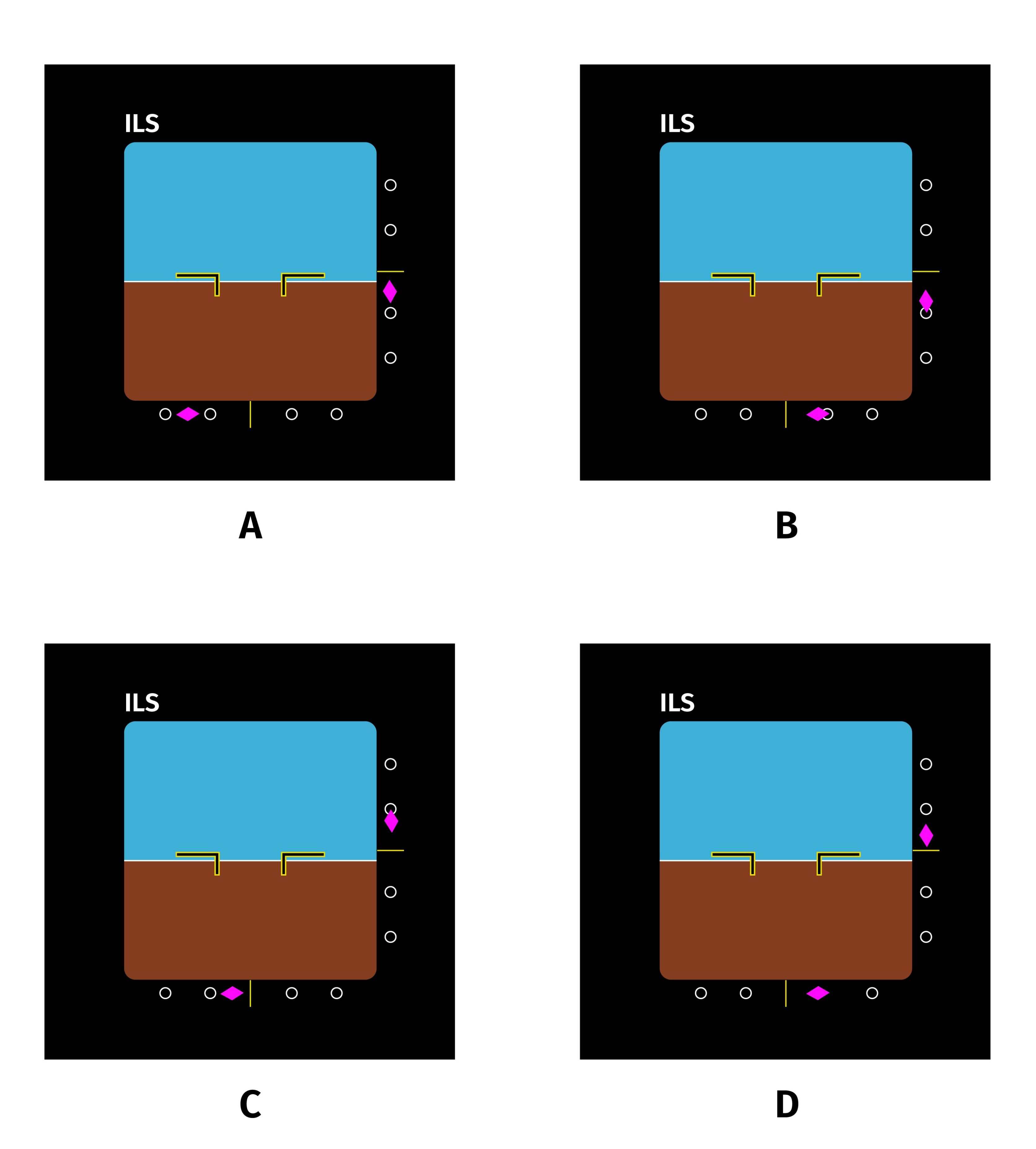
Refer to figure. When intercepting the glide path from below and from the left, which PFD shows the correct indications to begin descending on the glide path?
Select the answer:Select the answer
1 correct answer
A.
Figure D
B.
Figure C
C.
Figure B
D.
Figure A
.
Right Answer: A
Quiz
Question 3/103/10
Global Navigation Satellite Systems (GNSS)
Global Navigation Satellite Systems (GNSS)
Global Navigation Satellite Systems (GNSS)
What is the minimum number of satellites required for signal reception in order to carry out an independent three-dimensional fix, Receiver Autonomous Integrity Monitoring (RAIM) and failure detection and exclusion of any faulty satellite?
Select the answer:Select the answer
1 correct answer
A.
4
B.
5
C.
6
D.
7
For signal reception to carry out an independent three-dimensional fix, Receiver Autonomous Integrity Monitoring (RAIM), and failure detection and exclusion of any faulty satellite, a minimum of 6 satellites are required.
Right Answer: C
Quiz
Question 4/104/10
Performance-based Navigation (PBN)
Performance-based Navigation (PBN)
Performance-based Navigation (PBN)
Concerning PBN - Performance Based Navigation - what is the name of a curved terminal or approach section, defined by fix, radius & arc length?
Select the answer:Select the answer
1 correct answer
A.
Radius approach
B.
Fixed arc approach
C.
Fixed radius path
D.
Curved terminal approach
The curved terminal or approach section, defined by fix, radius & arc length in PBN is called a Fixed radius path.
Right Answer: C
Quiz
Question 5/105/10
Radar
Radar
Radar
Which of the following equipment uses primary radar principles (PSR)?
Select the answer:Select the answer
1 correct answer
A.
Airborne weather radar (AWR).
B.
Distance Measuring Equipment (DME).
C.
Global Positioning System (GPS).
D.
Secondary Surveillance Radar (SSR).
Primary Surveillance Radar (PSR) equipment uses primary radar principles, not Airborne Weather Radar (AWR). Primary radar systems emit radio waves which are reflected by aircraft and detected by the radar unit to determine the position and distance of the aircraft.
Right Answer: A
Quiz
Question 6/106/10
Basic Radio Propagation Theory
Basic Radio Propagation Theory
Basic Radio Propagation Theory
A radio signal may be classified by three symbols according to the International Telecommunication Union (ITU) code. The abbreviation A3E is used for the type of transmission in which the carrier wave is....
Select the answer:Select the answer
1 correct answer
A.
amplitude modulated by a speech signal, such as is used for VHF-COM
B.
a continuous wave interrupted with a keyed Morse code ident as used by an NDB
C.
amplitude modulated to transmit the Morse code ident, as is used by a VOR
D.
interrupted to transmit the Morse code identification, as used by an NDB
The abbreviation A3E is used for the type of transmission in which the carrier wave is amplitude modulated by a speech signal, such as is used for VHF-COM.
Right Answer: A
Quiz
Question 7/107/10
Radio Aids
Radio Aids
Radio Aids
The TO/FROM indicator of a VOR:
Select the answer:Select the answer
1 correct answer
A.
tells whether you are now flying towards or from the VOR.
B.
tells whether a track equal to the selected bearing will bring you to or away from the VOR.
C.
tells whether the deviation indicator shows that you should manoeuvre the aircraft towards or from the CDI needle.
D.
tells whether you should turn the aircraft towards or away from the CDI indication.
The TO/FROM indicator of a VOR tells whether a track equal to the selected bearing will bring you to or away from the VOR.
Right Answer: B
Quiz
Question 8/108/10
Global Navigation Satellite Systems (GNSS)
Global Navigation Satellite Systems (GNSS)
Global Navigation Satellite Systems (GNSS)
User Equivalent Range Error (UERE) or User Range Error (URE) is a signal-in-space error consisting of several individual errors. One of these individual errors is variations to the satellite orbit, or ephemeris, which is caused by...
Select the answer:Select the answer
1 correct answer
A.
solar winds and gravitational forces of the Sun and the Moon.
B.
jet streams and areas of significant weather along the orbit.
C.
high solar activity causing variations to the depth of the ionosphere.
D.
stronger than forecast ionospheric winds and electromagnetic forces.
User Equivalent Range Error (UERE) or User Range Error (URE) is a signal-in-space error consisting of several individual errors. One of these individual errors is variations to the satellite orbit, or ephemeris, which is caused by solar winds and gravitational forces of the Sun and the Moon.
Right Answer: A
Quiz
Question 9/109/10
Performance-based Navigation (PBN)
Performance-based Navigation (PBN)
Performance-based Navigation (PBN)
What ground/air based systems must be used to comply with RNP/RNAV 10 requirements ?
Select the answer:Select the answer
1 correct answer
A.
None of the above.
B.
DME/DME
C.
VOR/DME
D.
DME/DME/IRU
To comply with RNP/RNAV 10 requirements, no ground/air based systems must be used.
Right Answer: A
Quiz
Question 10/1010/10
Radar
Radar
Radar
The operating mode of a transponder depends on the...
Select the answer:Select the answer
1 correct answer
A.
length of the interrogation pulses.
B.
time interval between the interrogation pulse pairs.
C.
frequency of the carrier wave.
D.
repetition frequency of interrogation pulse pairs.
The operating mode of a transponder depends on the time interval between the interrogation pulse pairs.
CBIR (A) - Navigation Radio Navigation (PBN) Practice Exam Practice test unlocks all online simulator questions
Thank you for choosing the free version of the CBIR (A) - Navigation Radio Navigation (PBN) Practice Exam practice test! Further deepen your knowledge on CBIR - Competency Based Instrument Rating License Test for Aeroplane Simulator; by unlocking the full version of our CBIR (A) - Navigation Radio Navigation (PBN) Practice Exam Simulator you will be able to take tests with over 30 constantly updated questions and easily pass your exam. 98% of people pass the exam in the first attempt after preparing with our 30 questions.
What to expect from our CBIR (A) - Navigation Radio Navigation (PBN) Practice Exam practice tests and how to prepare for any exam?
The CBIR (A) - Navigation Radio Navigation (PBN) Practice Exam Simulator Practice Tests are part of the CBIR - Competency Based Instrument Rating License Test for Aeroplane Database and are the best way to prepare for any CBIR (A) - Navigation Radio Navigation (PBN) Practice Exam exam. The CBIR (A) - Navigation Radio Navigation (PBN) Practice Exam practice tests consist of 30 questions divided by 5 topics and are written by experts to help you and prepare you to pass the exam on the first attempt. The CBIR (A) - Navigation Radio Navigation (PBN) Practice Exam database includes questions from previous and other exams, which means you will be able to practice simulating past and future questions. Preparation with CBIR (A) - Navigation Radio Navigation (PBN) Practice Exam Simulator will also give you an idea of the time it will take to complete each section of the CBIR (A) - Navigation Radio Navigation (PBN) Practice Exam practice test . It is important to note that the CBIR (A) - Navigation Radio Navigation (PBN) Practice Exam Simulator does not replace the classic CBIR (A) - Navigation Radio Navigation (PBN) Practice Exam study guides; however, the Simulator provides valuable insights into what to expect and how much work needs to be done to prepare for the CBIR (A) - Navigation Radio Navigation (PBN) Practice Exam exam.
CBIR (A) - Navigation Radio Navigation (PBN) Practice Exam Practice test therefore represents an excellent tool to prepare for the actual exam together with our CBIR - Competency Based Instrument Rating License Test for Aeroplane practice test . Our CBIR (A) - Navigation Radio Navigation (PBN) Practice Exam Simulator will help you assess your level of preparation and understand your strengths and weaknesses. Below you can read all the quizzes you will find in our CBIR (A) - Navigation Radio Navigation (PBN) Practice Exam Simulator and how our unique CBIR (A) - Navigation Radio Navigation (PBN) Practice Exam Database made up of real questions:
Info quiz:
Quiz name:CBIR (A) - Navigation Radio Navigation (PBN) Practice Exam
Total number of questions:30
Number of questions for the test:100
Pass score:70%
Number of topics:5 Topics
Study topics:Number of questions:
Basic Radio Propagation Theory:6 Questions
Global Navigation Satellite Systems (GNSS):2 Questions
Performance-based Navigation (PBN):10 Questions
Radar:2 Questions
Radio Aids:10 Questions
You can prepare for the CBIR (A) - Navigation Radio Navigation (PBN) Practice Exam exams with our mobile app. It is very easy to use and even works offline in case of network failure, with all the functions you need to study and practice with our CBIR (A) - Navigation Radio Navigation (PBN) Practice Exam Simulator.
Use our Mobile App, available for both Android and iOS devices, with our CBIR (A) - Navigation Radio Navigation (PBN) Practice Exam Simulator . You can use it anywhere and always remember that our mobile app is free and available on all stores.
Our Mobile App contains all CBIR (A) - Navigation Radio Navigation (PBN) Practice Exam practice tests which consist of 30 questions that are divided by 5 topics and also provide study material to pass the final CBIR (A) - Navigation Radio Navigation (PBN) Practice Exam exam with guaranteed success.
Our CBIR (A) - Navigation Radio Navigation (PBN) Practice Exam database contain hundreds of questions and CBIR - Competency Based Instrument Rating License Test for Aeroplane Tests related to CBIR (A) - Navigation Radio Navigation (PBN) Practice Exam Exam. This way you can practice anywhere you want, even offline without the internet.