La nuova funzione delle flashcard è utile per memorizzare le domande.
?Cambia modalità di studio
In ogni istante puoi cambiare la modalità di studio, ed alternarti tra la modalità di pratica, e quella di esame. Nella modalità di pratica puoi configurare ad esempio il numero di domande o test, ed altri parametri per aiutarti a studiare.
Domande casuali | 10 Domande per Test | 20 Minuti | 70% per superamento|
Per ri-configurare di nuovo la tua modalità di studio e cambiare - ad esempio - il numero di test, il fatto di avere domande casuali o no e tutte gli altri parametri di configurazione
?Configurazione del simulatore
Auto-scroll: Puoi utilizzare lo scorrimento automatico del questionario che avviene appena rispondi correttamente ad uno o tutte le risposte di una domanda. L'auto scrolling si attiva se rispondi ad una risposta singola, oppure appena rispondi a tutte le risposte obbligatorie. Learning Mode: Durante la modalità di apprendimento puoi ottenere un risultato in tempo reale per la tua risposta.
Prova gratuita
Domanda: / 10
20:00Min. rimanenti
?Riavvia il test corrente
Per ri-iniziare il test corrente azzerando tutte le tue risposte e il tempo fino ad ora utilizzato. Attenzione: tutte le risposte andranno perse.
Domanda: / 10
4.9(624 Voti)
Quiz
Domanda 1/101/10
Basic Radio Propagation Theory
Basic Radio Propagation Theory
Basic Radio Propagation Theory
Given the following information, what is the true bearing from the NDB to the aircraft?Compass Heading: 241°Relative Bearing Indicator (RBI) - needle head: 162°Deviation: +3°Variation: 13°EThe effect of convergence can be ignored.
Seleziona la risposta:Seleziona la risposta
1 risposta corretta
A.
239°(T)
B.
223°(T)
C.
233°(T)
D.
213°(T)
The true bearing from the NDB to the aircraft is calculated by subtracting the Deviation (+3°) and Variation (13°E) from the Compass Heading (241°). Therefore, 241° - 3° - 13° = 225°. Since the RBI needle head is at 162°, the relative bearing is 162° which means the aircraft is 162° to the right of the true bearing. To find the true bearing, we subtract the relative bearing from the calculated bearing, so 225° - 162° = 63°. However, since the RBI shows the bearing from the aircraft to the NDB, we take the reciprocal of 63° which is 243°. Hence, the true bearing from the NDB to the aircraft is 243°(T).
Risposta Corretta: A
Quiz
Domanda 2/102/10
Radio Aids
Radio Aids
Radio Aids
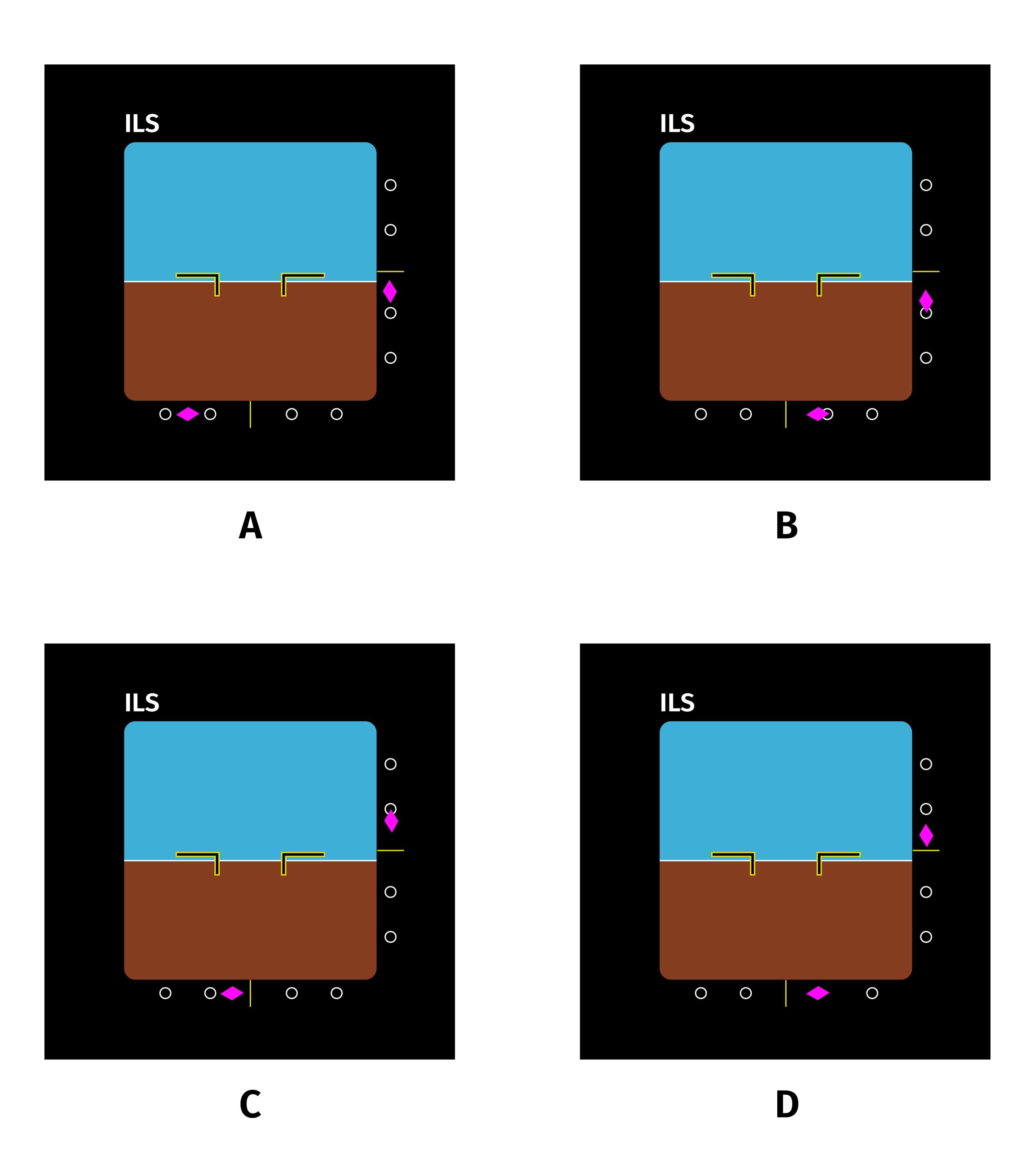
Refer to figure. When intercepting the glide path from below and from the left, which PFD shows the correct indications to begin descending on the glide path?
Seleziona la risposta:Seleziona la risposta
1 risposta corretta
A.
Figure D
B.
Figure C
C.
Figure B
D.
Figure A
.
Risposta Corretta: A
Quiz
Domanda 3/103/10
Global Navigation Satellite Systems (GNSS)
Global Navigation Satellite Systems (GNSS)
Global Navigation Satellite Systems (GNSS)
What is the minimum number of satellites required for signal reception in order to carry out an independent three-dimensional fix, Receiver Autonomous Integrity Monitoring (RAIM) and failure detection and exclusion of any faulty satellite?
Seleziona la risposta:Seleziona la risposta
1 risposta corretta
A.
4
B.
5
C.
6
D.
7
For signal reception to carry out an independent three-dimensional fix, Receiver Autonomous Integrity Monitoring (RAIM), and failure detection and exclusion of any faulty satellite, a minimum of 6 satellites are required.
Risposta Corretta: C
Quiz
Domanda 4/104/10
Performance-based Navigation (PBN)
Performance-based Navigation (PBN)
Performance-based Navigation (PBN)
Concerning PBN - Performance Based Navigation - what is the name of a curved terminal or approach section, defined by fix, radius & arc length?
Seleziona la risposta:Seleziona la risposta
1 risposta corretta
A.
Radius approach
B.
Fixed arc approach
C.
Fixed radius path
D.
Curved terminal approach
The curved terminal or approach section, defined by fix, radius & arc length in PBN is called a Fixed radius path.
Risposta Corretta: C
Quiz
Domanda 5/105/10
Radar
Radar
Radar
Which of the following equipment uses primary radar principles (PSR)?
Seleziona la risposta:Seleziona la risposta
1 risposta corretta
A.
Airborne weather radar (AWR).
B.
Distance Measuring Equipment (DME).
C.
Global Positioning System (GPS).
D.
Secondary Surveillance Radar (SSR).
Primary Surveillance Radar (PSR) equipment uses primary radar principles, not Airborne Weather Radar (AWR). Primary radar systems emit radio waves which are reflected by aircraft and detected by the radar unit to determine the position and distance of the aircraft.
Risposta Corretta: A
Quiz
Domanda 6/106/10
Basic Radio Propagation Theory
Basic Radio Propagation Theory
Basic Radio Propagation Theory
A radio signal may be classified by three symbols according to the International Telecommunication Union (ITU) code. The abbreviation A3E is used for the type of transmission in which the carrier wave is....
Seleziona la risposta:Seleziona la risposta
1 risposta corretta
A.
amplitude modulated by a speech signal, such as is used for VHF-COM
B.
a continuous wave interrupted with a keyed Morse code ident as used by an NDB
C.
amplitude modulated to transmit the Morse code ident, as is used by a VOR
D.
interrupted to transmit the Morse code identification, as used by an NDB
The abbreviation A3E is used for the type of transmission in which the carrier wave is amplitude modulated by a speech signal, such as is used for VHF-COM.
Risposta Corretta: A
Quiz
Domanda 7/107/10
Radio Aids
Radio Aids
Radio Aids
The TO/FROM indicator of a VOR:
Seleziona la risposta:Seleziona la risposta
1 risposta corretta
A.
tells whether you are now flying towards or from the VOR.
B.
tells whether a track equal to the selected bearing will bring you to or away from the VOR.
C.
tells whether the deviation indicator shows that you should manoeuvre the aircraft towards or from the CDI needle.
D.
tells whether you should turn the aircraft towards or away from the CDI indication.
The TO/FROM indicator of a VOR tells whether a track equal to the selected bearing will bring you to or away from the VOR.
Risposta Corretta: B
Quiz
Domanda 8/108/10
Global Navigation Satellite Systems (GNSS)
Global Navigation Satellite Systems (GNSS)
Global Navigation Satellite Systems (GNSS)
User Equivalent Range Error (UERE) or User Range Error (URE) is a signal-in-space error consisting of several individual errors. One of these individual errors is variations to the satellite orbit, or ephemeris, which is caused by...
Seleziona la risposta:Seleziona la risposta
1 risposta corretta
A.
solar winds and gravitational forces of the Sun and the Moon.
B.
jet streams and areas of significant weather along the orbit.
C.
high solar activity causing variations to the depth of the ionosphere.
D.
stronger than forecast ionospheric winds and electromagnetic forces.
User Equivalent Range Error (UERE) or User Range Error (URE) is a signal-in-space error consisting of several individual errors. One of these individual errors is variations to the satellite orbit, or ephemeris, which is caused by solar winds and gravitational forces of the Sun and the Moon.
Risposta Corretta: A
Quiz
Domanda 9/109/10
Performance-based Navigation (PBN)
Performance-based Navigation (PBN)
Performance-based Navigation (PBN)
What ground/air based systems must be used to comply with RNP/RNAV 10 requirements ?
Seleziona la risposta:Seleziona la risposta
1 risposta corretta
A.
None of the above.
B.
DME/DME
C.
VOR/DME
D.
DME/DME/IRU
To comply with RNP/RNAV 10 requirements, no ground/air based systems must be used.
Risposta Corretta: A
Quiz
Domanda 10/1010/10
Radar
Radar
Radar
The operating mode of a transponder depends on the...
Seleziona la risposta:Seleziona la risposta
1 risposta corretta
A.
length of the interrogation pulses.
B.
time interval between the interrogation pulse pairs.
C.
frequency of the carrier wave.
D.
repetition frequency of interrogation pulse pairs.
The operating mode of a transponder depends on the time interval between the interrogation pulse pairs.
Quiz e Simulatore: Quiz CPL (H) Radio Navigation - sblocca tutte le domande del simulatore online
Grazie per aver scelto la versione free del Quiz Quiz CPL (H) Radio Navigation! Approfondisci ulteriormente le tue conoscenze con i nostri Simulatori Licenza di Pilota Commerciale Elicottero; Sbloccando la versione completa del nostro Simulatore Quiz CPL (H) Radio Navigation potrai effettuare test e quiz con oltre 804 domande sempre aggiornate e superare facilmente la tua prove d’esame. Il 98% di persone che si sono esercitate con le nostre 804 domande hanno superato l'esame al primo tentativo.
Cosa aspettarsi dai nostri test di pratica per Quiz CPL (H) Radio Navigation e come prepararsi a qualsiasi esame?
I Test pratici di Quiz CPL (H) Radio Navigation fanno parte della Banca Dati Licenza di Pilota Commerciale Elicottero e rappresentano il modo migliore per prepararsi a qualsiasi esame per Quiz CPL (H) Radio Navigation. I quiz sono composti da 804 domande divise per 5 argomenti e sono scritti da esperti per aiutarvi e prepararvi a raggiungere l’obiettivo di superare l’esame al primo tentativo. La banca dati per Quiz CPL (H) Radio Navigation include domande apparse in esami precedenti e non solo, il che significa che sarete in grado di esercitarvi simulando le domande passate e future. La preparazione al Test Quiz CPL (H) Radio Navigation vi offrirà anche un’idea del tempo necessario per completare ogni sezione del Quiz Quiz CPL (H) Radio Navigation. È importante notare che il Simulatore Quiz CPL (H) Radio Navigation non sostituisce le classiche guide Quiz CPL (H) Radio Navigation di studio; tuttavia, il Simulatore fornisce indicazioni preziose su cosa aspettarsi e su quanto lavoro occorra fare per prepararsi all'esame Quiz CPL (H) Radio Navigation.
I Quiz Quiz CPL (H) Radio Navigation rappresentano quindi un ottimo strumento per prepararsi all’esame vero e proprio assieme ai nostri Quiz Licenza di Pilota Commerciale Elicottero. I nostri test ti aiuteranno a valutare il tuo livello di preparazione e a comprendere i tuoi punti di forza e debolezza. Di seguito potrai leggere tutti i quiz che troverai nel nostro Simulatore Quiz CPL (H) Radio Navigation e come è composta la nostra unica Banca Dati Quiz CPL (H) Radio Navigation fatta di domande vere e reali:
Info quiz:
Nome del quiz:Quiz CPL (H) Radio Navigation
Numero totale di domande:804
Numero di domande per il test:100
Punteggio di superamento:70%
Numero di argomenti:5 argomenti
Argomenti di studio:Numero di domande:
Basic Radio Propagation Theory:133 domande
Global Navigation Satellite Systems (GNSS):136 domande
Performance-based Navigation (PBN):136 domande
Radar:100 domande
Radio Aids:299 domande
Potete prepararvi agli esami Quiz CPL (H) Radio Navigation anche con la nostra applicazione mobile. È molto facile da usare e funziona anche off-line in caso di mancata disponibilità di rete, con tutte le funzioni necessarie per studiare ed esercitarvi con la nostra Banca Dati Quiz CPL (H) Radio Navigation.
Utilizzate la nostra Applicazione Mobile, disponibile sia per Android che per iOS, con il nostro Simulatore Quiz CPL (H) Radio Navigation. Potete utilizzarla ovunque e ricordate sempre che la nostra applicazione mobile è gratuita e disponibile su tutti gli Store.
L’applicazione mobile contiene tutti i Quiz Quiz CPL (H) Radio Navigation per un totale di 804 domande divisi per 5 argomenti e fornirà il materiale di studio per superare l’esame finale con un successo garantito.
Le nostre Banche Dati Quiz CPL (H) Radio Navigation contengono centinaia di domande relative all'Esame Quiz CPL (H) Radio Navigation e ai Test Licenza di Pilota Commerciale Elicottero. In questo modo sarà possibile esercitarsi quando e dove volete anche in modalità offline.